

How it Changed: Three Eras of Search
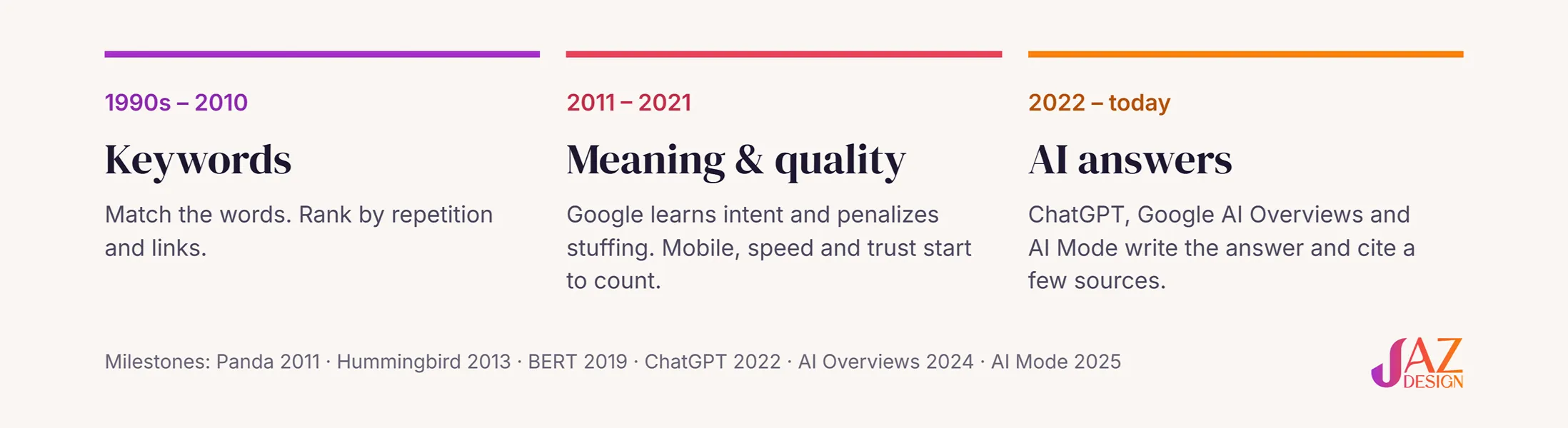
The landscape shifted with the advent of the Link-Building Era. Search engines, led by Google’s PageRank innovation, began valuing inbound links as indicators of authority and relevance. SEO strategies evolved to focus on cultivating backlinks, leading to both organic outreach and, at times, manipulative link schemes. Quality content started to matter, but the primary metric was still the volume and quality of links pointing to a page.
Today, we are immersed in the AI-Powered Era. Algorithms now interpret search intent, context, and user engagement, leveraging artificial intelligence to deliver more nuanced, relevant results. SEO practices have become holistic, prioritizing content quality, semantic relevance, and authentic user value. This progression underscores how SEO has matured from mechanical tactics to a dynamic, intelligent discipline—setting the stage for the next chapter in digital discovery.
What’s Changed: From Ranking to Being Sited
Search engine optimization has undergone a seismic shift in recent years. Whereas traditional SEO strategies revolved around achieving top rankings for targeted keywords, the landscape has now evolved into something far more dynamic. The focus has moved beyond merely appearing at the top of search engine results pages (SERPs); today, the emphasis lies in becoming a trusted source that is referenced—or “sited”—by advanced AI-powered search engines and digital assistants.
This evolution has been driven by the rise of generative AI technologies, which synthesize information from various sources to deliver concise, authoritative answers. Instead of serving up a long list of blue links, modern search engines increasingly curate content, pulling insights from reputable websites and citing them directly within their responses. As a result, the goal is no longer just visibility but credibility: to have your content chosen and acknowledged as a source by these intelligent systems.
For businesses and creators, this means optimizing not only for keywords but also for quality, originality, and trustworthiness. The path to digital prominence is no longer paved solely by rankings, but by establishing your website as a reliable reference point in the evolving world of search.
How AI Answers Are Transforming Search Engine Optimization
The landscape of search engine optimization is undergoing a profound transformation, driven by the rise of AI-generated answers. Traditional SEO strategies once focused heavily on keyword placement and link-building, aiming to secure top spots in search engine results pages. However, artificial intelligence is rewriting these rules. Search engines now leverage advanced algorithms and natural language processing to deliver direct, conversational responses to user queries, often without the need for users to click through to external websites.
Shifting User Expectations
With AI-powered search features, users expect immediate, contextually relevant answers. This shift is compelling businesses and content creators to rethink how they structure information, prioritizing clarity, accuracy, and concise delivery. The growing prevalence of featured snippets, knowledge panels, and voice search means that content must be optimized for both search algorithms and human understanding.
Redefining SEO Success Metrics
Success in this evolving environment is not solely determined by rankings or traffic, but by visibility within AI-driven answer formats. SEO specialists now focus on semantic search, structured data, and user intent, ensuring that their content is positioned to be selected by AI as the definitive answer. This evolution marks a pivotal moment in the ongoing integration of artificial intelligence within digital marketing strategies.
Is traditional SEO still relevant
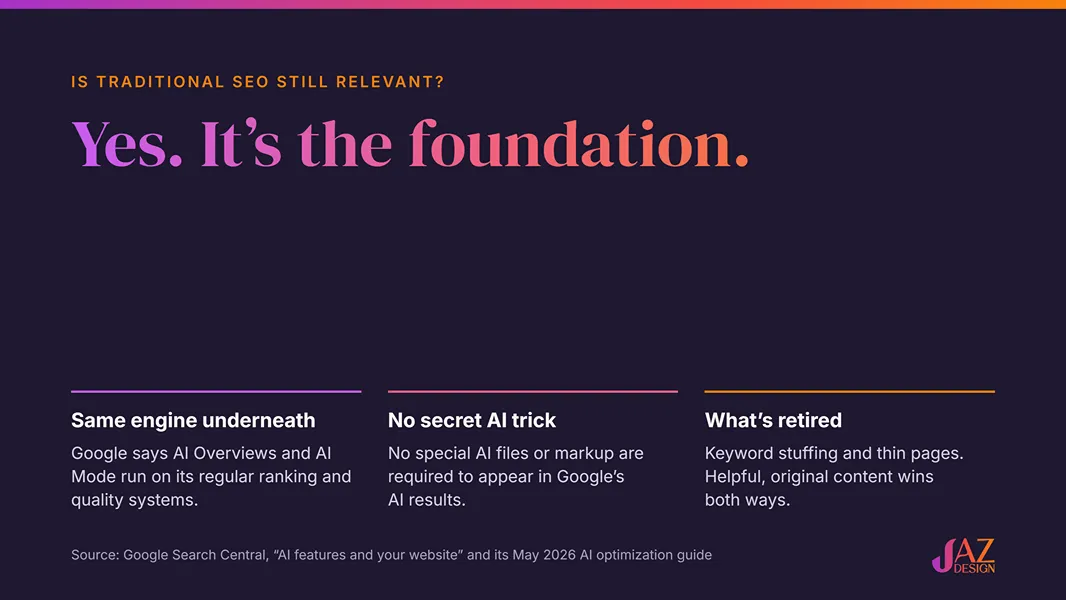
While the digital ecosystem is more sophisticated than ever, traditional SEO is far from obsolete. Instead, it has adapted, integrating new techniques without abandoning its core. Search engines still rely on well-structured websites, relevant keywords, and authoritative content to determine rankings. However, there is a greater emphasis on user intent, high-quality content, and seamless site experiences. Technical SEO—such as site speed, mobile-friendliness, and secure connections—now plays a pivotal role alongside classic tactics.
Ultimately, traditional SEO forms the foundation upon which modern optimization strategies are built. Embracing both the time-tested basics and innovative approaches ensures long-term visibility and competitiveness as search engines—and users—continue to evolve.
what to put on your website
Six ways to get cited by AI
1. Answer questions directly
Add an FAQ page. Start each service page with a one-sentence answer to the question a customer would ask. AI tools quote content they can lift in a sentence or two.
2. Show real expertise
Team bios, case studies, your process and original work only you can offer. AI favors sources that clearly know their subject.
3. Add structured data
Use schema markup to label your business, services and reviews. Make sure it matches what’s visible on the page.
4. Keep it crawlable
Fast pages, clear headings and links between related pages. Check that your site isn’t accidentally blocking AI crawlers.
5. Be consistent everywhere
Use the same business name, address, phone and services on your site, Google Business Profile and directories.
6. Earn mentions off-site
Reviews, press, guest articles and partner links give AI a second opinion that you’re trustworthy.
where to start
Three simple next steps
-
This Week
Ask ChatGPT and Google about your business and your services. Note what they say and who they cite.
-
This Month
Fix the basics: page speed, clear headings, an up-to-date Google Business Profile and consistent contact details.
-
Ongoing
Add FAQs, case studies and reviews a little at a time.
By following these steps, you lay a solid foundation for success in an era where both keywords and AI-powered answers shape search visibility.
The Takeaway
Write for People. Structure it for Machines.
Good SEO hasn’t gone away. It has become the foundation that AI search is built on.
0 Comments